

The Importance of Thanks

The holidays are here again. Along with the turkey, stuffing, and loved ones, there’s more to consider. This season is a time of giving thanks. One of the topics I’m often asked to speak about is personal branding. And, part of your personal brand comes across in the way that you say thank you to others. After you interview for a new job, it’s always a good idea to say thanks. For the most part, I think we can all agree on this idea. But, the question is really – how do exactly do you do it? What’s the best way to say thank you, and what are you saying thank you for?
Think of yourself as a salesperson. You’re selling your services. The company and the hiring manager – they are your customer. You may say, “But, Angela – I really put a lot of work into the interview. It was not easy on me at all.” I get that, and I don’t disagree with you. But, the hiring manager is still the customer, and they will ultimately make the decision on whether or not you’re hired. With that in mind, saying thanks is critical.
The very best solution is to two fold. First, send a thank you email the afternoon after your interview. Then, write a hand written note to drop in the mail. The company may make a decision quickly, so the email ensures your message will get there in time. The handwritten note however is the one that will make you really stand out from your competition. In all likelihood, you will be the only candidate who sent a handwritten note.
Each email and each handwritten note should be personal and sent to just one person. Ideally, send one to each person who interviewed you along the way. The note itself should be brief. You want to thank the person for interviewing you, and if possible, mention something from your conversation. But, stay positive. If you are afraid the interview went badly, this isn’t the time to bring it up. The most important thing is to say thanks.
During a presentation I recently gave on this topic, someone in the audience asked a great question. “In the age of the internet, is it really important to send something that’s handwritten?” The answer is yes. Hiring decisions are not made on the internet. They’re made in real life. People hire people. And, they hire people who they like. The more that you can remember this, the more you’ll increase your odds at landing a job offer.
An online thank you card doesn’t replace a hand written note. I’m sure you may remember the last time you received a hand written thank you note. You may even still have it somewhere. I know that I do. I appreciate these notes, and I keep them. So do other people – including hiring managers. They will keep your hand written message and it will influence them in both this decision, and in the future.
Angela Copeland is a Career Coach and Founder of Copeland Coaching and can be reached at CopelandCoaching.com or on Twitter at @CopelandCoach.
What is Your Biggest Weakness?

One of the favorite interview questions of hiring managers continues to be, “What is your biggest weakness?” This is a tough question all the way around. If you are too honest, you may eliminate yourself from consideration and not get the job at all. But, if you’re not honest enough, you may come across as evasive.
So, what can you do when you’re asked this question during a job interview?
The very first thing to do is prepare. There’s a good chance you will be asked this question, so think about it in advance. Write down how you might answer the question, and practice your answer. Share your thoughts with a friend (or two), and get feedback. Find out what you could do better, and put time into perfecting your response.
Don’t give an answer that is truly critical to the job. For example, if you are interviewing to be a project manager, don’t confess that you struggle with organization and are often late on deadlines. These qualities are key to succeeding as a project manager and would immediately eliminate you from consideration.
On the other extreme, don’t give an answer that is not genuine. Many job seekers tend to give answers along the lines of, “I just work so hard. I can’t stop myself.” Or, “I’m such an overachiever and I have high expectations of those around me.” These answers come across as not being authentic, and no hiring manager will want to hear them.
Instead, I like to think of this question as an opportunity to address the elephant in the room (assuming there is one). For example, I was once asked to consider a part time coaching role with a large organization. During the job interview, the hiring manager asked me, “What is your biggest weakness?”
This was my response. “As you know, I don’t come from a human resources background, like many coaches do. That may be considered a weakness in comparison. However, I have extensive corporate experience in many industries and many job functions – from engineering to marketing. I have interviewed for many different roles myself, and I’m able to bring my own authentic experience to the table to help job seekers do their best.”
In this case, my hiring manager already knew that I had not worked in human resources. It was clear from my resume. She was probably trying to decide whether or not this difference in my background was a problem. Because I brought the issue up directly, I was able to put it to rest quickly. It also gave me a chance to explain why my own unique experience would be an asset to the organization, and might even give me a leg up on my competition. My answer worked well and created space to talk openly about my background.
There’s no one right way to answer this question. In order to give your best answer, prepare in advance. It will allow you to turn your potential weakness into a perceived strength.
Angela Copeland is a Career Coach and Founder of Copeland Coaching and can be reached at CopelandCoaching.com or on Twitter at @CopelandCoach.
Don’t Overlook Company Reviews
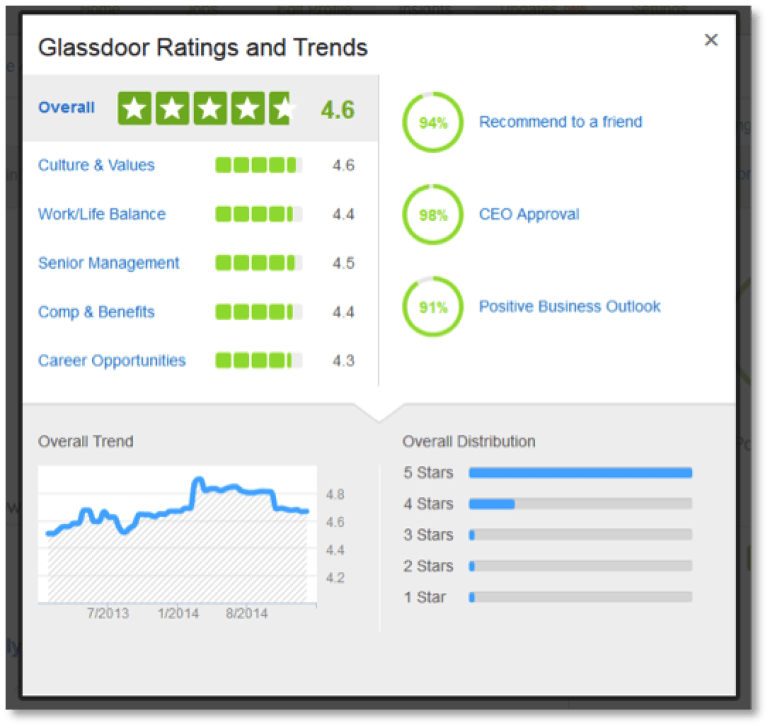
Being happy at work is an essential part of career fulfillment. Sometimes, it seems we spend more time researching where to eat the best hamburger than where to work. Much like skipping restaurant reviews, failing to research a company can come back to burn you later. The good news is that you no longer have to know someone personally to get the scoop on a company.
There are many employment related websites, including Glassdoor.com and Indeed.com, where current and former employees can leave anonymous reviews about their experiences. If you read the reviews, you’ll often notice patterns. Much like hotel reviews, those who leave reviews are either very happy or very unhappy. Have you ever noticed that many hotel reviews are left by customers who had some kind of awful experience, like bed bugs or dirty sheets? Typically, to be motivated to take the time to leave a review, an employee (much like a hotel guest) must have extreme emotions about the place where they work.
Glassdoor recently released a study on this very topic. They wanted to take a look into how balanced online employer reviews really are. Glassdoor’s study wanted to find out whether their site provides more or less balanced reviews than other review sites. In other words, are all of the company reviews very negative or very positive, like the hotel reviews.
If you’ve used Glassdoor before, you already know this. The site is free. But, in order to use it, Glassdoor requires you to leave some type of feedback on a company where you have worked (past or present). Glassdoor uses what they call a “give to get” policy. In other words, it encourages everyone to leave a review – not just those who are unhappy. As you may have guessed, this policy encourages people to leave reviews that are more neutral in nature.
“This study gives strong evidence that company reviews on Glassdoor are more balanced because of the way they are collected. The policy creates incentive for people to contribute to the site, who may otherwise opt out. It should help quell misconceptions that employees only provide really positive or really negative opinions about companies on Glassdoor. The data show that’s not the case — Glassdoor’s give to get policy creates a more balanced picture of companies,” said Dr. Andrew Chamberlain, Glassdoor chief economist.
Another great feature on both Glassdoor and Indeed is this. Although the websites have a financial relationship with hiring companies (companies pay them to advertise their jobs), the sites don’t allow employers to edit employee reviews. In other words, just because an employer doesn’t care for a particular negative review, Glassdoor and Indeed won’t delete it. The company must face the review and correct the problem directly with the employee.
In order to increase the odds that your next workplace will be a positive one, don’t skip the company reviews. They’re there to help give you a little insight into what it’s really like to work at a particular company.
Angela Copeland is a Career Coach and Founder of Copeland Coaching and can be reached at CopelandCoaching.com or on Twitter at @CopelandCoach.
Increasing Your Executive Presence

I recently had the honor of speaking on the topic of executive presence, not just once – but twice. I participated in panels where we discussed the importance of executive presence to your career and how to increase yours.
The first question that comes to mind is, “What is executive presence, anyway?” There are many ways to answer this question. Business Insider says that it’s made up of these seven traits: composure, connection, charisma, confidence, credibility, clarity, and conciseness.
As it’s clear, many of these qualities are superficial. It’s unfortunate, but it makes sense. First impressions are made in about seven seconds. And, a hiring manager makes their decision about four minutes into the job interview. That doesn’t leave much time to make a good first impression.
Executive presence is even more important when you’re new to a field, or when you’re different in some way. At my first job, I redesigned parts on cars for General Motors. I was nineteen and twenty years old. Soon after starting, the plant manager called my boss and said, “Who is this little girl, and what is she doing with MY cars?”
It quickly became clear to me that in order to get my job done, I needed to do my best to fit in. As time went on, I worked to refine my own executive presence. I dressed more formally. I worked to speak more loudly and confidently. I paid attention to my posture. I made a point to be on time, and to keep the commitments that I made.
My devotion to this idea helped. Despite being young, I was promoted to director at twenty-seven and vice president five years later.
Don’t get me wrong. The types of biases described are not necessarily fair. Many are not terribly related to our ability to do a job or our intelligence. But, they are real. Because of that, it’s important to be aware of them and of how they influence your career.
So what can you do if you want to increase your executive presence? One of the best things is to observe those around you. For example, what do your colleagues at work wear? How do they communicate during meetings? Then, consider the details, such as how you react under pressure and whether or not you follow through on your commitments.
Your colleagues will notice these things when they decide how they feel about you. Work to be genuine. Even if you’re professional, if your presence is off-putting, it won’t help you in the long run.
The feelings others have toward you will have a large impact on your career success. Often, our success in business isn’t just about how smart we are. It’s about how good we are with people. And, how well we work together with people is influenced by our own executive presence.
If you’re struggling to achieve career goals, this could be a moment to take a step back and look for opportunities to grow your executive presence.
Angela Copeland is a Career Coach and Founder of Copeland Coaching and can be reached at CopelandCoaching.com or on Twitter at @CopelandCoach.
Using social media in your job search

Social media isn’t part of a job search. In order to find a job, you only need a resume, business cards, and a nice suit. Right? This was true – if you were looking for a job in 2001.
In today’s wired world, there are so many more options available to you. Why not try them? After all, submitting your resume blindly just isn’t working. If you want to try something new, social media is a great place to start.
Hands down, the best social media site for the job seeker is LinkedIn. It’s an extension of your resume and a Rolodex of your contacts all rolled into one. I often hear the question, “Do I really need a LinkedIn page?” The short answer is yes. LinkedIn is free and it allows you to decide how much you share and with whom you want to connect. In fact, there are estimated to be half a billion users on LinkedIn from over 200 countries.
Use LinkedIn to expand on your resume, connect to old colleagues, and grow your network. The LinkedIn search tool is a great way to find (and to connect with) your future boss. It can also be a great way to learn who else works at your target company.
But, don’t stop there. I have been impressed at the number of business executives who use Twitter. It’s not uncommon to tweet to someone in the C-suite, and to actually receive a real response. It can be an unexpected way to grow a new relationship.
Another site you may want to consider if you’re in a creative field is YouTube. An advertising agency CEO once shared with me that some of her most impressive applicants submitted a short video about themselves via YouTube. It helped them to get the agency’s attention in a sea of other applications.
The one social media I would think twice about using is Facebook. Facebook has long been considered a private space to connect with friends and family. In fact, if you send a stranger a direct message, Facebook will typically filter it out of their inbox by default. That means that the person may never see your message. So, before using Facebook, try other social media sites.
Using social media in your job search can give you a leg up on your competition. It can also help you to shape your online presence. After all, when a company searches for your name on Google, your social media pages are certain to be the first thing that pops up. Think of Google search results like the new cover letter. Your social media pages tell a personal narrative about you and your beliefs.
Don’t worry too much about bothering the person you’re contacting via LinkedIn or Twitter. Social media is just another form of communication, similar to email or phone. Be professional and polite and you’ll find an entirely new way to grow your network. It’s far more effective than blindly submitting an application on a website.
Angela Copeland is a Career Coach and Founder of Copeland Coaching and can be reached at CopelandCoaching.com or on Twitter at @CopelandCoach.


Copeland Coaching Podcast


You must be logged in to post a comment.